Lebanon
A named herb blend and a lentil soup
Wael Karram identifies his zaatar blend as Palestinian-Lebanese. The Lebanese-style lentil soup provides a separate complete cooking card. Follow the source-specific use of leaves, seeds, spices and legumes.
From the kitchen
Something to bring to your table.
 Recipe
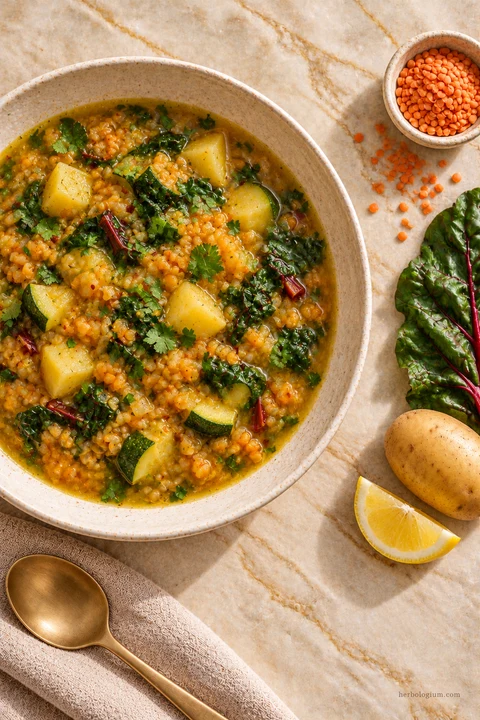
Lebanese-style lentil soup
Red lentils share the pot with chard, potatoes and zucchini; lemon is added near the end.
AI-generated illustration: OpenAI image generation · Herbologium art direction. Lebanese-style lentil soup — AI-generated serving illustration. https://herbologium.com/recipe-illustrations.json · AI-generated illustration; no blanket reuse license stated · AI-generated food scene refined to use Taj Mahal quartzite, flax linen and brushed brass, with a small visible herbologium.com mark. Separate portrait and landscape compositions; responsive sizes and JPEG/WebP encoding with embedded AI provenance.
The recipe publisher files this version under Lebanese recipes. This is a source classification, not a claim of invention or exclusive ownership.
 Recipe
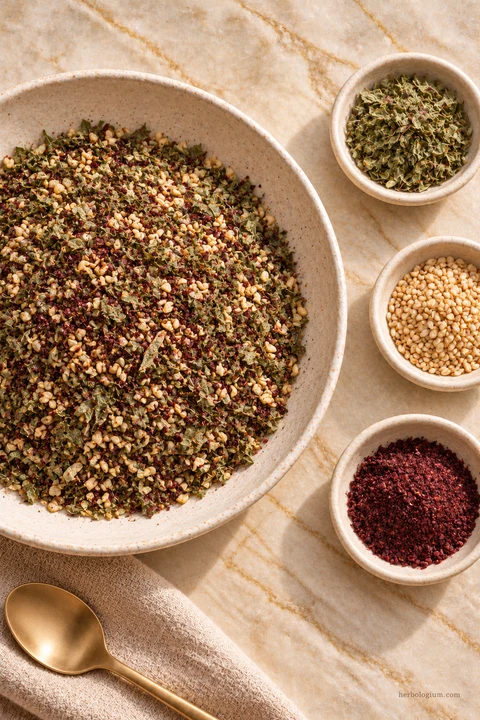
Zaatar
Wael Karram’s Palestinian-Lebanese zaatar blend combines dried zaatar leaves, sesame and sumac.
AI-generated illustration: OpenAI image generation · Herbologium art direction. Zaatar — AI-generated serving illustration. https://herbologium.com/recipe-illustrations.json · AI-generated illustration; no blanket reuse license stated · AI-generated food scene refined to use Taj Mahal quartzite, flax linen and brushed brass, with a small visible herbologium.com mark. Separate portrait and landscape compositions; responsive sizes and JPEG/WebP encoding with embedded AI provenance.
The pinned contributor’s title, categories or explicit introduction supports this source-version connection. It does not establish an invention, historical origin or a universal national preparation.
Meet the ingredients
Plants beside these readings.
Ingredients and plants in the selected sources; their presence here does not establish a native range or origin.
People, practice & time
Stay for the story.
Historical accounts are still to be added to this collection. The recipe sources above establish its present geographical connections.
THE THINGS WE PASS ON
Keep these recipes in a booklet.
Gather public recipes, regional folios and your family cards into a collection to print. Keep the original words, scans, names and stories together; add cooking notes when you want them.
Begin with a sourced public recipe or regional folio, or add your own family recipes and stories.
Keep the source beside the place.
The blend source does not identify the zaatar leaf to botanical species, so no thyme-species link is inferred. The two contributor versions do not stand for every Lebanese table.
skipper-davies · Lebanese Lentil Soup ↗ https://publicdomainrecipes.com/lebanese-lentil-soup/
Wael Karram · Public Domain Recipes · Zaatar ↗ https://publicdomainrecipes.com/zaatar/
Suggest a source correction →Follow your curiosity
A few paths into the collection.
One ingredient, many tables
Follow maize from a documented food system to a separately sourced polenta recipe. A comparison of uses, not a claimed route of transmission.
Follow this trail →02 · 3 stopsBreads and grains
Compare a raised loaf, a soft oatcake and a flatbread through their source recipes.
Follow this trail →03 · 4 stopsThe many preparations of lentils
Three source-named versions, with their different ingredients and methods kept intact.
Follow this trail →04 · 3 stopsPlants in celebration and remembrance
Keep a meal, a commemoration and a literary account distinct while following their plants.
Follow this trail →05 · 3 stopsFood traditions across places
Read the kimjang account, then examine a separate contemporary fresh cabbage preparation without treating the two as the same recipe.
Follow this trail →