Algeria
Steam, grain and a shared heritage
A complete Wikibooks couscous preparation joins the Maghreb folio. The recipe uses a two-stage steam and a meat-and-vegetable stew; its chickpeas, grain and vegetables lead into ingredient profiles.
From the kitchen
Something to bring to your table.
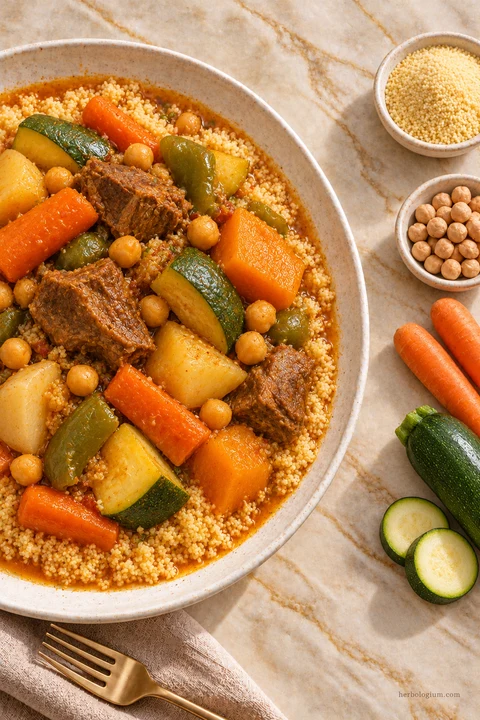 Recipe
Algerian couscous with meat and vegetables
Twice-steamed couscous served with a spiced meat, chickpea and vegetable stew.
AI-generated illustration: OpenAI image generation · Herbologium art direction. Algerian couscous with meat and vegetables — AI-generated serving illustration. https://herbologium.com/recipe-illustrations.json · AI-generated illustration; no blanket reuse license stated · AI-generated food scene refined to use Taj Mahal quartzite, flax linen and brushed brass, with a small visible herbologium.com mark. Separate portrait and landscape compositions; responsive sizes and JPEG/WebP encoding with embedded AI provenance.
The contributor recipe is explicitly filed as Algerian. This locates this particular version; the wider couscous heritage remains shared across the Maghreb.
Meet the ingredients
Plants beside these readings.
Ingredients and plants in the selected sources; their presence here does not establish a native range or origin.
People, practice & time
Stay for the story.
The Maghreb ↗
Couscous connects cereal growing, milling, utensils and knowledge learned by watching others.
The UNESCO inscription is shared by Algeria, Mauritania, Morocco and Tunisia. This country grouping describes the inscription, not the full extent of couscous traditions.
Couscous: grain, steam and a named cook ↗
Ourrad’s recipe describes separating and steaming couscous grains. Parsley, mint, garlic, onion and thyme appear in its ingredient list. The recipe’s meat and broth remain part of its identity.
The UNESCO inscription is shared by Algeria, Mauritania, Morocco and Tunisia. This country grouping describes the inscription, not the full extent of couscous traditions.
THE THINGS WE PASS ON
Keep these recipes in a booklet.
Gather public recipes, regional folios and your family cards into a collection to print. Keep the original words, scans, names and stories together; add cooking notes when you want them.
Begin with a sourced public recipe or regional folio, or add your own family recipes and stories.
Keep the source beside the place.
This is a credited contributor version. The UNESCO record documents shared couscous knowledge across Algeria, Mauritania, Morocco and Tunisia, not exclusive ownership or this particular formula.
UNESCO · UNESCO’s inscription of couscous traditions, an example of international cultural cooperation ↗ https://www.unesco.org/en/articles/unescos-inscription-couscous-traditions-example-international-cultural-cooperation
Wikibooks contributors (see page history) · Cookbook:Algerian Couscous with Meat and Vegetables ↗ https://en.wikibooks.org/wiki/Cookbook:Algerian_Couscous_with_Meat_and_Vegetables
Suggest a source correction →Follow your curiosity
A few paths into the collection.
One ingredient, many tables
Follow maize from a documented food system to a separately sourced polenta recipe. A comparison of uses, not a claimed route of transmission.
Follow this trail →02 · 3 stopsBreads and grains
Compare a raised loaf, a soft oatcake and a flatbread through their source recipes.
Follow this trail →03 · 4 stopsThe many preparations of lentils
Three source-named versions, with their different ingredients and methods kept intact.
Follow this trail →04 · 3 stopsPlants in celebration and remembrance
Keep a meal, a commemoration and a literary account distinct while following their plants.
Follow this trail →05 · 3 stopsFood traditions across places
Read the kimjang account, then examine a separate contemporary fresh cabbage preparation without treating the two as the same recipe.
Follow this trail →