South Korea
Making and sharing kimchi
Read the kimjang account for its historical and social context. A complete fresh cabbage, ginger and gochugaru salad offers a separate contemporary cooking companion, with its own ingredients and editorial development record.
From the kitchen
Something to bring to your table.
 Recipe
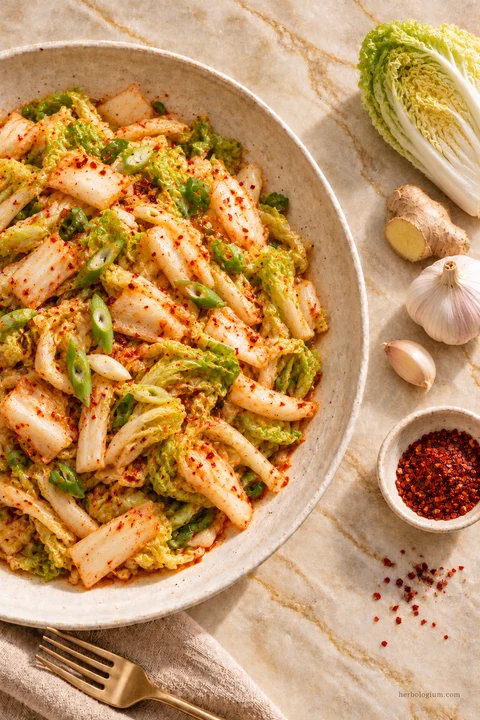
Fresh cabbage with ginger and gochugaru
A fresh, unfermented napa-cabbage salad with ginger, garlic and Korean chile flakes.
AI-generated illustration: OpenAI image generation · Herbologium art direction. Fresh cabbage with ginger and gochugaru — AI-generated serving illustration. https://herbologium.com/recipe-illustrations.json · AI-generated illustration; no blanket reuse license stated · AI-generated food scene refined to use Taj Mahal quartzite, flax linen and brushed brass, with a small visible herbologium.com mark. Separate portrait and landscape compositions; responsive sizes and JPEG/WebP encoding with embedded AI provenance.
A contemporary unfermented cabbage salad offered beside a reading about kimjang. The historical source supports the reading context, not this new formula. This salad is not Hooni Kim’s recipe, fermented kimchi or a reconstruction of kimjang.
Meet the ingredients
Plants beside these readings.
Ingredients and plants in the selected sources; their presence here does not establish a native range or origin.
People, practice & time
Stay for the story.
Korea ↗
Kimjang brings seasonal preserving, household knowledge and shared work into the same story.
A scholar’s overview and one named chef’s recipe demonstrate different kinds of evidence. They do not represent every household or establish a single unchanged kimchi.
Reading a kimchi recipe with its author ↗
Hooni Kim’s published recipe includes salted shrimp and fish sauce, alongside vegetables and rice flour. Preserve those ingredients in its description; a plant-only version would be an adaptation with its own credit.
A scholar’s overview and one named chef’s recipe demonstrate different kinds of evidence. They do not represent every household or establish a single unchanged kimchi.
THE THINGS WE PASS ON
Keep these recipes in a booklet.
Gather public recipes, regional folios and your family cards into a collection to print. Keep the original words, scans, names and stories together; add cooking notes when you want them.
Begin with a sourced public recipe or regional folio, or add your own family recipes and stories.
Keep the source beside the place.
The cooking companion is unfermented and is not a kimchi recipe or Hooni Kim’s preparation. The historical account and the new formula answer different questions; neither represents every Korean household.
Youngha Joo · ICH Courier · Traditional Knowledge Contained in Kimjang, the Ancient Practice of Kimchi Making ↗ https://ichcourier.unesco-ichcap.org/board.es?act=view&bid=A102&list_no=419&mid=a10501000000
Suggest a source correction →Follow your curiosity
A few paths into the collection.
One ingredient, many tables
Follow maize from a documented food system to a separately sourced polenta recipe. A comparison of uses, not a claimed route of transmission.
Follow this trail →02 · 3 stopsBreads and grains
Compare a raised loaf, a soft oatcake and a flatbread through their source recipes.
Follow this trail →03 · 4 stopsThe many preparations of lentils
Three source-named versions, with their different ingredients and methods kept intact.
Follow this trail →04 · 3 stopsPlants in celebration and remembrance
Keep a meal, a commemoration and a literary account distinct while following their plants.
Follow this trail →05 · 3 stopsFood traditions across places
Read the kimjang account, then examine a separate contemporary fresh cabbage preparation without treating the two as the same recipe.
Follow this trail →